Geographies of Horror.
Host and dates: University of Zadar, Croatia | 20-21 May 2027.
Deadline for submissions: 1 October 2026.
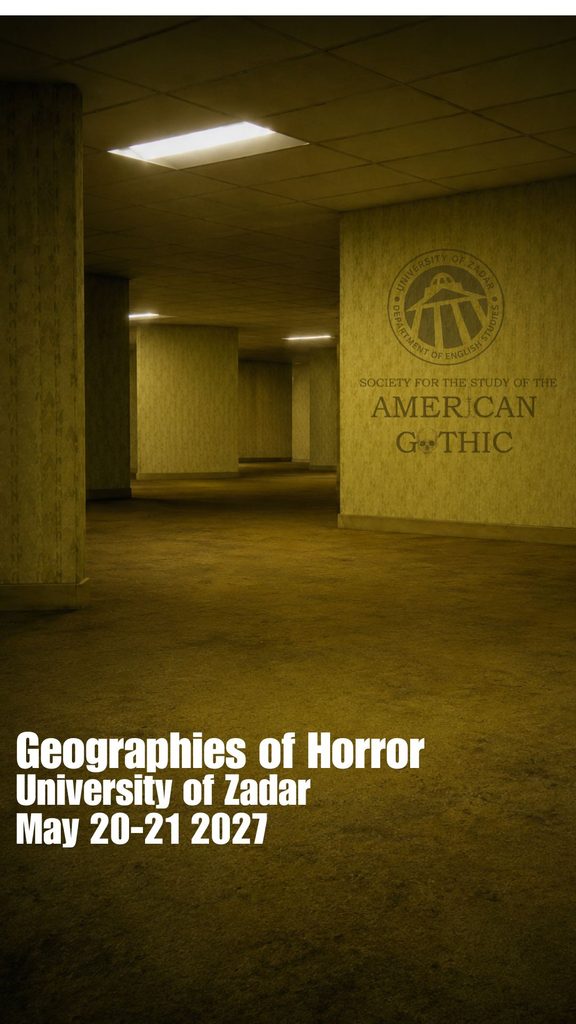
Event organised by Department of English Studies, University of Zadar.
Event presentation
The study of horror has always been inseparable from the question of space. From the shadowed corridors of Gothic castles to contemporary digital voids, spaces in horror are never just passive backdrops. They function as active agents that shape perception, destabilize subjectivity, and collapse the distinction between interior and exterior, revealing how fragile our sense of spatial coherence can be. This conference seeks to understand how spaces become haunted – materially, symbolically, psychologically, and technologically, and how these hauntings articulate broader cultural anxieties, historical traumas, and epistemological uncertainties.
At the same time, horror increasingly stages the breakdown of spatial logic itself. Non-Euclidean geometries, infinite corridors, and paradoxical environments destabilize perception and challenge epistemological certainty. In these instances, space becomes fundamentally unknowable, aligning with cosmic horror and philosophical pessimism. These concerns extend into digital and virtual environments, where video games, online narratives, and immersive technologies generate new forms of spatial horror. Phenomena such as The Backrooms exemplify liminal, endlessly reproducible environments that evoke both familiarity and existential dread. Simultaneously, haunted space becomes internalized within the body and mind, as psychological and body horror depict interiority as fragmented and invasive.
The keynote speaker for the event will be Professor Jeffrey Andrew Weinstock (Central Michigan University). He is a Professor of English at Central Michigan University, where he teaches a range of courses on American literature and popular culture. He is the founder and president of The Society for the Study of the American Gothic, the founder and general editor of the peer-reviewed journal American Gothic Studies, and the co-founder and past chair of the Modern Language Association Gothic Studies Forum. He also serves as the associate editor in charge of horror for the Los Angeles Review of Books and is currently the general editor for Bloomsbury Publishing’s six-volume Cultural History of Monsters series.
Website address
Contact details
 Marko Lukic, geographyhorror@gmail.com
CFP
For further details, please check the original call inserted below.
 Call_for_Papers_Geographies
(Posted 18 September 2026)
World CLIL 2027: Embracing the ‘C’ in CLIL.
Host and dates: University of Koblenz, Germany | 21-22 May 2027.
Online submissions: 15 November 2026.
Event presentation
1. Embracing the ‘C’ in CLIL: Highlighting the content-subject and best practice is a conference for participants of all educational levels, that is researchers (including early career researchers), practitioners (teachers and teacher trainers), policy makers, and interested others, to come together to share, reflect, discuss, and debate insights under the conference theme, meant to fully integrate content and language in a
The following observations can be made at any educational level – from primary school to secondary and tertiary education:
On the one hand, CLIL research, driven by applied linguists in collaboration with content experts, predominantly focuses on the learning and teaching of language, while the learning and teaching of the content receive considerably less attention. On the other hand, classroom practice indeed frequently focuses on the subject – that is the content – but primarily uses language as the medium of instruction. The challenge seems to further integrate content and language true to the original concept of CLIL.
“To rope in the content people”, the plea voiced at World CLIL 2025, is one step that we want to take at World CLIL 2027 to address this challenge.
To join forces to really embrace the ‘C’, we invite participants to share their findings and experiences in research and practice on the integration of the learning and teaching of content and language(s).
Let’s exchange new ideas, inspirations, and best practice examples to fulfil the mandate of CLIL.
Kindly refer to the submission guidelines online on  www.worldclil.com
  for further practical information. See also the document attached below.
2. Embracing the ‘C’ in CLIL: Highlighting the content-subject and best practice also invites teachers and practitioners across all educational levels to actively contribute to our conference meant to fully integrate content and language.
The following observations can be made at any educational level – from primary school to secondary and tertiary education:
On the one hand, classroom practice indeed frequently focuses on the subject – that is the content – but primarily uses language as the medium of instruction. On the other hand, CLIL research, driven by applied linguists in collaboration with content experts, predominantly focuses on the learning and teaching of language, while the learning and teaching of the content receive considerably less attention. The challenge seems to further integrate content and language true to the original concept of CLIL.
One step that we want to take at World CLIL 2027 to address this challenge is to bring classroom expertise to the centre of the discussion and “to rope in the content people”, as called for by several keynote speakers at World CLIL 2025.
We invite teachers as experts of practice to join us in exploring what it means to truly embrace the ‘C’ in CLIL systematically by sharing selected teaching sequences as best practice examples.
A unique part of the conference will be a sequence of teaching spotlights across subjects and educational levels. We specifically encourage teachers and practitioners of subjects that are not necessarily considered the “classical CLIL subjects”, such as Music, Physical Education, Arts, Mathematics, Chemistry, This way, we hope to connect theory and practice and collaboratively reflect on a potential systematic progression of content and language complexity across subjects along different age levels.
Contributors will receive our full support in this process. We offer:
- a shared framework to connect individual sessions into a coherent overall sequence
- conceptual support in preparing your session
- opportunities for exchange and alignment with other contributors
Let’s join forces to truly embrace the ‘C’ in CLIL by bringing together research and authentic classroom practice.
We warmly invite you to contribute your expertise, ideas, and teaching experience to this collaborative format.
Kindly refer to the submission guidelines online at www.worldclil.com for further practical information. See also the document attached below.
Submissions
(Posted 9 September 2026)