Reverberations of 1776: receiving, rewriting and reappropriating the American Revolution across the Atlantic. Britain, France, Germany, 1776-1876.
Host and dates: Université Bordeaux Montaigne, Pessac, France. 1-3 October 2026.
Deadline for submissions: 15 September 2025.
Event presentation
Université Bordeaux Montaigne and Universität Duisburg-Essen are pleased to announce the 4th annual LAPASEC (Landau-Paris Symposia on the Eighteenth Century) early-career conference. This conference gives early career researchers a chance to network and present, and to get to know a few well-established figures in the field. It is open to students of many disciplines, including history, literature, British studies, American studies, German studies, Romance studies, visual arts, musicology, history of law…
The three-day conference looks at the reverberations of the Declaration of Independence and the American Revolution, in the British Isles, France and Germany in the late eighteenth century and the greater part of the nineteenth century, up to and including the centenary celebrations of the event. The ways in which 1776 resonated with the French Revolutions of 1789, 1830, 1848 and other revolutions in Europe, including fear of revolution, are also of special relevance.
It is fitting for Bordeaux, France’s major Atlantic seaport in the eighteenth century, to celebrate the 250th anniversary of the Declaration of Independence. Bordeaux had strong commercial ties with Northern America, and played a role in the American Revolution, for instance welcoming John Adams’s ambassadorial visit in 1778. The city also saw the opening of the world’s first US consulate, which was housed in the Hôtel Fenwick, still in existence today; Consul Fenwick was a figure of Bordeaux society until 1801.
It is well established that enlightened thinkers across Europe hailed independent America as a republic without kings, nobles or established clergy, while, in many cases, deploring that slavery continued after Independence, despite abolition in Pennsylvania and Vermont. Transnational abolitionist movements developed in Britain and France, and debates on American slavery reached well beyond Atlantic shores into German-speaking central Europe. This conference seeks to look beyond well-known figures and envisions the reception of the American Revolution not just as an American “influence”, or a “model”, on European elites, but as a process of transatlantic exchange and cultural transfer beyond the elite public and familiar themes.
Topics may include political and constitutional, as well as economic progress, but also the literary and imaginative uses of America in the decades following the Declaration of Independence. The 1876 centenary defines a period when the Fourth of July, and more broadly, America, was celebrated, but also criticized and redefined. Attention should be paid to the circulation of American texts, images, symbols and practices beyond pamphlets and political discourse, in literature and the multiple stories and histories (official, personal, intimate) written in the century after 1776.
Possible areas of investigation include:
- Transmission, translation, transnational networking
- Honouring, celebrating, commemorating the revolution (festivals, centenaries, homages, statues, heroes and heroines, pantheons…)
- Criticizing, rejecting, selecting aspects of the American Revolution
- Artistic and literary responses and elaborations in the Romantic era and beyond
Possible fields of research include:
- Political and intellectual history
- Literature
- Gender studies
- Minority studies
- Museum studies, heritage studies
- Visual arts, architecture, music…
- Fashion
- Philosophy
- Linguistics
- Economics
Applicants are encouraged to adopt cross-disciplinary, cross-cultural approaches in the abovementioned fields. They are invited to think about connections between their own research and the conference topic.
For those in the early stages of their academic careers, we are seeking to fund travel, accommodation and related conference costs.
Timeline
- Submission deadline: 15 September 2025
- Notification of acceptance: 30 October 2025
A 500-word proposal and a short bio-bibliographical presentation should be sent to the members of the organizing committee at:  lapasec2026@gmail.com
The conference will use the French, German and English languages. Proposals in any of the three languages are welcome.
CFP
For further details, please check the original call inserted below.
 CfP LAPASEC 2026
(Posted 21 July 2025)
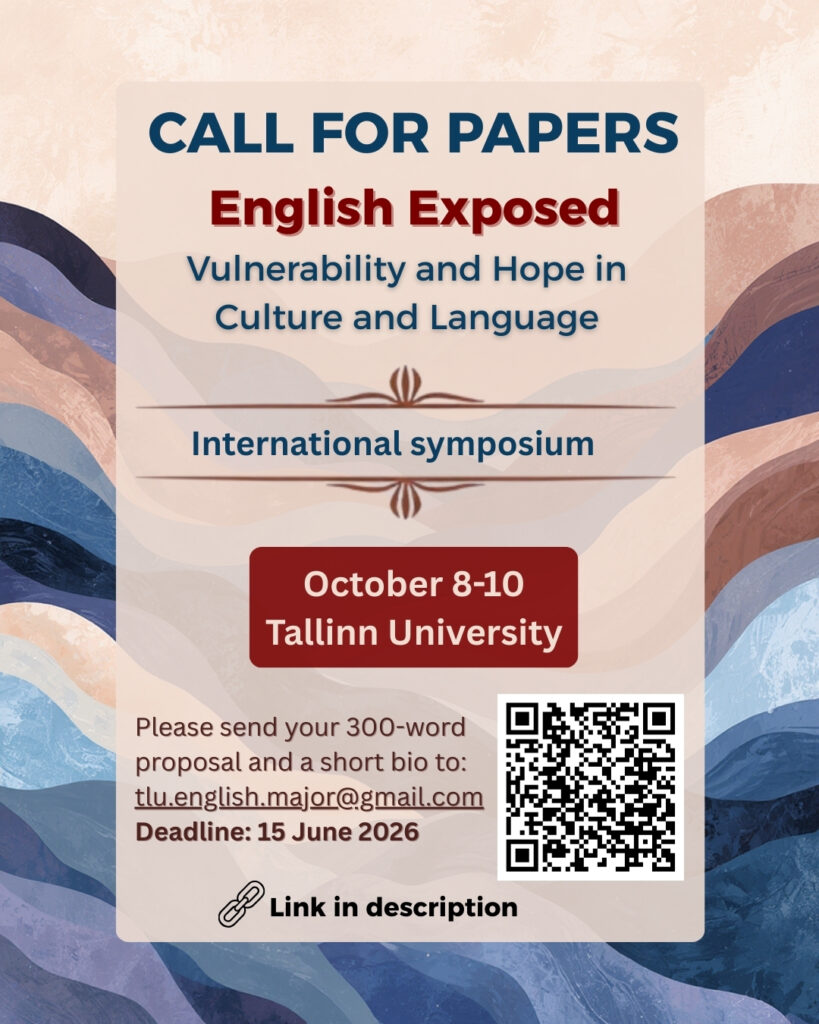
English Exposed: Vulnerability and Hope in Culture and Language International Symposium.
Host and dates: Tallinn University, School of Humanities. 8-10 October 2026.
Deadline for submissions: 15 June 2026.
Venue details: Tallinn University, Estonia.
Event presentation
In a world marked by overlapping crises—wars, epidemics, climate catastrophe, democratic erosion, technological acceleration, and the growing entanglement of artificial intelligence with everyday communication—vulnerability has emerged as an increasingly recognised condition. English, as a global language of culture, education, governance, and digital mediation, is deeply implicated in these processes: it both exposes subjects to new forms of precarity and offers resources for articulation, resilience, care, and hope.
How to think about vulnerability in today’s world? Is it to be resolved or can we conceive of it as a condition to be accepted and embraced? Is it helplessness and lack of agency or is it a relational, affective and ethical condition? How can it be reconceptualised and recognised for its potential to generate new forms of creativity, solidarity, and critical hope?
This symposium invites scholars working across literary studies, cultural studies, linguistics, and language education to explore how vulnerability manifests in the world and is represented in and through English and Anglophone cultures today. Drawing on recent theoretical work on fear (Han 2024a), survival societies, pain (2020) hope (Han 2024b), critical attention (Citton 2017, Ganteau 2023, 2024), and narrative engagement beyond the human (Caracciolo 2021, 2024), the symposium asks how cultural and linguistic practices respond to a present marked by anxiety, exhaustion, and exposure. How do literary, artistic, cinematic, and discursive forms register contemporary vulnerabilities? How does English function simultaneously as a site of domination and of shared agency, whether in local, global, or intercultural lingua franca contexts? What kinds of futures—pedagogical, political, aesthetic—can be imagined from within conditions of vulnerability?
We particularly welcome contributions that engage vulnerability not only as a theme but as a method, stance, or practice, including creative-critical and interdisciplinary approaches.
The symposium will combine academic panels with film screening and poetry reading, creating a space for dialogue between scholarly analysis and artistic practice.
We invite proposals for 20-minute papers or (where appropriate) practice-based or creative-critical contributions.
Please send a 300-word proposal and a short bio to: tlu.english.major@gmail.com by 15 June 2026.
Acceptance notifications will be sent by 25 June.
Confirmed keynote speakers:
- Marco Caracciolo (Ghent University)
- Hannah Lowe (award-winning British writer and poet)
Website address
 https://www.tlu.ee/en/english-exposed-vulnerability-and-hope-culture-and-language
Contact details
Please address your queries to: Prof Julia Kuznetski: julia.kuznetski@tlu.ee
CFP
For further details, please check the original call inserted below.
(Posted 11 March 2026)
Waterphors 2026.
Host and dates: CIRM (Centro Interuniversitario di Ricerca sulle Metafore) in Genoa, Italy. 22 and 23 October 2026.
Deadline for submissions: 31 March 2026.
Venue details: CIRM (Centro Interuniversitario di Ricerca sulle Metafore – https://cirm.unige.it ), in Genoa, Italy.
Event presentation
Following the first edition in 2024 in Lyon, the second Waterphors conference will be held on 22 and 23 October 2026 in collaboration with the CIRM (Centro Interuniversitario di Ricerca sulle Metafore – https://cirm.unige.it), in Genoa, Italy.
The CFP (in Italian, English and French) are available here https://cirm.unige.it/node/1134
How to submit a paper? All proposals should be sent to waterphors2026@gmail.com before 31 March 2026. Proposals (in French or English) must include a title, an abstract (maximum 500 words, not including the bibliography), 5 keywords, and a short presentation of the author. The theoretical and methodological framework and the study corpus must be clearly stated. Presentation length: 30 minutes maximum. All proposals will be anonymised before being submitted to the scientific committee for evaluation.
Website address
https://cirm.unige.it/node/1134
Contact details:
(Posted 7 Novemebr 2025)
Weathering Change: The Humanities in a Warming World.
Host and dates: The Department of Modern Languages, Faculty of Letters, University of Craiova, Romania. 22-24 October 2026.
Deadline for submissions: 15 May 2026.
Institutional partners: Edinburgh Napier University and The Humanities and Arts Research Centre
Event presentation
Human concerns with weather patterns can be traced back to Aristotle’s treatise Meteorologica, which shows that an active pursuit of truth about the physical world has existed since ancient times. Although people talk about the weather on a daily basis, the growing debates on environmental uncertainty, climate change, and new technological challenges have become more prominent in both the humanities and sciences.
Unlike contemporary scientific directions, classical to late Renaissance meteorology showed little interest in predicting future weather conditions. In the classical model, weather patterns fluctuated constantly and were regarded as nature’s accidents. In Europe, until the late seventeenth century, the weather was popularly understood as part of a broader heavenly design: in Macbeth the weather bends to the witches’ own will, echoing a similar disruption in natural order depicted in Henry V: “The day is hot, and the weather, and the wars, and the King, and the dukes” (3.2: 108-9). From the eighteenth century onward, constant attempts were made to domesticate weather patterns through systematic records, using more accurate meteorological instruments. This new approach turned the once unpredictable force of nature into a measurable natural phenomenon.
Today, weather conditions and especially extreme weather events are often seen as directly related to anthropogenic effects on Earth systems caused by human activities such as deforestation, urbanization, extensive livestock farming and global emissions coming from burning fossil fuels. In Anthropocene Fictions. The Novel in a Time of Climate Change (2015), Adam Trexler uses the geological framework of the newly identified Anthropocene era to explore how contemporary fiction reflects the cultural transformation shaped by the climate change rhetoric. The environmental humanities and life sciences work in tandem to respond to the unstable vulnerability of humanity when confronted with the consequences of extreme weather events.
Engaging with severe weather conditions and rising temperatures from a perspective that is both grounded in the humanities and humanitarian in focus can create a large-scale public awareness and understanding of climate change that will enable individuals and communities to meet the challenges of long-term shifts in temperatures and weather patterns. As scholars in the humanities, our responsibility is to revise and reshuffle disciplinary fields, methods, and methodologies in order to adapt them to contemporary crises. Since environmental studies encompasses ecocriticism, eco theory, anthropology, literature, ecolinguistics, sustainability studies, queer theory, feminism and their epistemological kin, we invite proposals that explore and reflect on new directions of the humanities, including recent theories and new challenges arising from weather and climate variability.
Topics may include, but are not limited to:
- climate change fiction (cli-fi) and drama
- eco-poetry and environmental degradation
- weather imagery/symbolism in literature
- environmental literature and ecocriticism
- extremes of weather and temperature in literature
- geological and climate hauntings in literature
- climate change and language diversity
- ecolinguistics and discourses of climate change
- environmental metaphors, framing, and rhetoric
- climate communication, terminology, and scientific discourse
- language policy, sustainability, and eco-communication
- climate change and environmental topics in foreign-language teaching
- ecopedagogy and sustainability-oriented curricula
- environmental literacy and multimodal learning
- digital tools and AI in language learning for sustainability
Keynote speakers:
- Assoc. Prof. Emily Alder, Edinburgh Napier University
- Assoc. Prof. Carmen Veronica Borbely, Babeș-Bolyai University, Cluj
The languages of the conference are English and German.
Website address: https://litere.ucv.ro/litere/ro/content/llcp-home
Contact details: llcpconference2026@gmail.com
CFP
For further details, please check the event original call inserted below.
(Posted 4 February 2026)
Unbound, Unfinished, Ongoing: Kate Zambreno Symposium.
Host and dates: Online, Complutense University of Madrid & University of Zaragoza. 23 October 2026.
Deadline for submissions: 1 July 2026.
Event organised by:
- Rubén Peinado Abarrio (University of Zaragoza),
- Laura de la Parra Fernández (Complutense University of Madrid) &
- Sofía Martinicorena (Zaratiegui Complutense University of Madrid)
Venue details: Online
Event presentation
Kate Zambreno is one of the most audacious and innovative writers today. Moving between the essay and the diary, autofiction and criticism, Zambreno’s writing foregrounds the instability of genre. Their literary oeuvre reveals a sustained engagement with some of the most pressing feminist issues of our times: how to live (and write) a feminist life during late-stage capitalism? How to be a mother and an author while in the adjunct loop? How to remain hopeful in the face of climate catastrophe and the encroachment of fascism?
In their well-known Heroines (2012), Zambreno poses the question of a self that is multiply affected by others, written, as it were, in collaboration. In the resolutely autotheoretical Drifts (2020), they write the overconnected body of the pregnant subject. In To Write As If Already Dead (2021), half study of Hervé Guibert, half memoir of the 1990s New Narrative, they produce a book that is a friendship. In their more recent Tone (2023), the text literally performs a conversation with their friend and artist Sofia Samatar. Thus, Zambreno’s writing enacts a resistance to closed forms, challenging the idea of literature as a well-defined, consumer product. Rather, their work stands in the interruptions and cracks of life, presenting a self that refuses to be read linearly and who is in the process of constant reinvention and revision, in dialogue with others.
Our confirmed keynote speaker is Dr. Chloe Green (Australian National University).
Please send a 300-word abstract and a brief bio to zambrenosymposium@gmail.com by July 1st. Acceptance of proposals will be notified by July 15th. The conference will be held online on 30 October 2026. There will be no registration fee.
Website address: https://sites.google.com/view/kate-zambreno-symposium/
Contact details: zambrenosymposium@gmail.com
CFP
For further details, please check the original call inserted below.
(Posted 9 March 2026)
Women and/of the Empire(s): On the 150th Anniversary of Queen Victoria’s Proclamation as Empress of India (1876-2026).
Host and dates: University of Porto, 29-30 October 2026.
Deadline for submissions: 15 June 2026.
Event organised by CETAPS – Centre for English, Translation and Anglo-Portuguese Studies
Event presentation
Under the Royal Titles Act of 1876, Britain’s Queen Victoria, who had often, albeit informally, been called Empress of India, had the title officially added to her style. The nominal head of the most powerful country in the world henceforth matched the titles used by the monarchs of Germany, Austria-Hungary, Russia, and the Ottoman Empire. In a context of international rivalry, the overtones of grandeur were intended to instil a notion of British superiority as well as to flatter the “Mother of Europe”. Ironically, however, the new title was also an attempt to cover up how close British control over India had come to utter collapse due to the Indian Mutiny (also known in India, significantly, as the First War of Independence) less than two decades earlier. At the same time, Victoria’s proclamation as Empress arguably exalted her as a supreme figure of the age in a global perspective as much as highlighted the fact that she was a woman with visibility and power in a period that almost universally denied women a range of rights and opportunities that we have come to assume are integral to any modern, democratic society.
This conference will seek to explore the realities and the legacies of the Victorian Age, its monarch and its empire. It will focus on women, their engagement in private and public life, their experience of class, travel, migration, and cultural exchanges – on either side of the cultural divide involved in imperial encounters – as well as on how women writers, of Victorian and later periods, have engaged artistically and critically with such realities in their poetical and fictional works.
Although Queen Victoria provides the starting point for the conference, we are also interested in contributions dealing with other aspects of the imperial/colonial experience, not limited to the nineteenth century, women, or the British Empire. Comparative perspectives, as well as broader chronological approaches, are also welcome.
Website address
https://womenandempire.wordpress.com
Contact details
CFP
For further details, please check the event original call inserted below.
(Posted 21 January 2026)
Redefining Borders in British Literature: Global and Local Identity Before and After Brexit.
Host and dates: Roma Tre University, Rome, Italy. 29–30 October 2026.
Deadline for submissions: 15 May 2026.
Event organised by the Department of Foreign Languages, Literatures and Cultures, Roma Tre University Rome, Italy.
Event presentation
Convenors: Michela Compagnoni, michela.compagnoni@uniroma3.it and Lucia Esposito, ucia.esposito@uniroma3.it .
Keynote Speaker: Kristian Shaw (University of Lincoln)
June 2026 marks ten years since the Brexit referendum, a political event whose reverberations continue to shape the cultural imagination of the United Kingdom across Europe and beyond. A decade on, Brexit is not only a constitutional rupture but also a powerful cultural lens through which questions of identity, belonging, borders, and Britain’s place in the world have been revisited, contested, and narrativized. This is even more relevant if we think at the recall and transformation of the historical trope of Britain’s supposedly “splendid” distance from Europe, particularly within the current geopolitical scenarios swept by the winds of war. In this light we seek to explore how literary texts have tackled with recent cultural, political, and social questions while interrogating the broader anxieties, divisions, and narratives that have shaped the nation both before and after the 2016 referendum. The conference, therefore, also addresses what Kristian Shaw (2018) has defined as Brexlit, namely “fictions that either directly respond or imaginatively allude to Britain’s exit from the EU, or engage with the subsequent socio-cultural, economic, racial or cosmopolitical consequences of Britain’s withdrawal”, while looking back to the longer cultural and literary trajectories that preceded the referendum and underpinned its emergence.
We welcome papers on British literature from 2000 to the present, including fiction, poetry, and theatre by writers from across the UK and beyond – English, Scottish, Welsh, Northern Irish, and migrant or diasporic voices – whose works reflect the evolving complexities of Britishness in the contemporary era. Possible themes, that are central to both the Brexit debate and its wider cultural milieu, include: immigration and xenophobia; European identity and Euroscepticism; community, division, and social inequality; nostalgia and melancholic ideals of the past; the legacy of empire; and the reimagining of national identity.
The conference organisers invite prospective participants to submit proposals for 20-minute papers. Proposals may address, but are not limited to, the following topics:
- Narratives of immigration, mobility, borders, and xenophobia before and after Brexit
- British identity in a changing political and sociocultural landscape
- Pre-Brexit imaginaries of Europe and British-European relations in literature since 2000
- Euroscepticism, nationalism, and the rhetoric of sovereignty in contemporary fiction, poetry, and theatre
- Nostalgia, melancholia, and idealised pasts in Brexit-era writing
- The legacy of empire and post-imperial memory in contemporary British literature
- Depictions of social inequalities, precarity, and regional divides pre- and/or post-Brexit
- Literary representations of Brexit and its cultural, social, and political reverberations, including populism, misinformation, and political fragmentation
- Theatre and performance responses to Brexit and its aftermath
- Community, solidarity, and rupture in post-referendum narratives
- Dystopian projections of contemporary political and cultural scenarios
- Repurposing traditional genres such as satire, allegory, and fairy tales
- The role of migrant, diasporic, and transnational British authors in reshaping debates around belonging and citizenship
- Literary engagements with European futures, cosmopolitanism, or the erosion thereof
Contact details
Please send an abstract of 250-300 words and a short biographical note (50-70 words) to
Timeline
- Submission deadline: 15 May 2026.
- Notification of acceptance: 31 May 2026.
CFP
For further details, please check the original call inserted below.
(Posted 14 March 2026)
“American Shorts” — An international conference on American short forms.
Host and dates: School of Arts and Humanities – University of Lisbon. 29-31 October 2026.
Deadline for submissions: 10 June 2026.
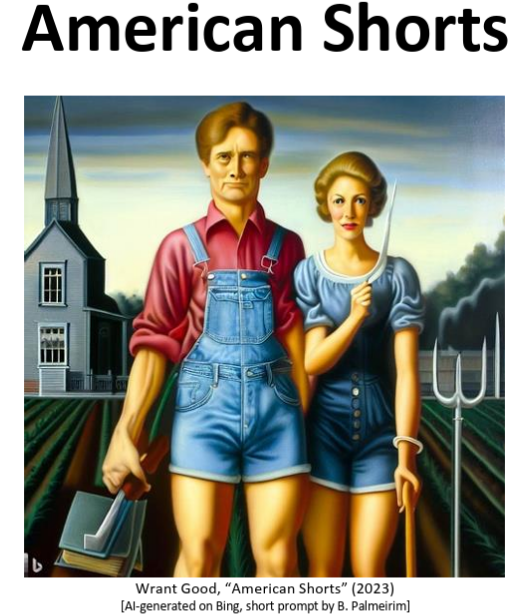
Event organised by The American Studies research group at ULICES (University of Lisbon Centre for English Studies) in partnership with SSASS (Society for the Study of the American Short Story), ENSFR (European Network for Short Fiction Research) and the Obama Institute for Transnational American Studies.
Event presentation
The contemporary American short story lives in a context where ‘short’ has tended towards the increasingly economic. Alongside a renewed interest in flash fiction, the 21st century has witnessed an explosion in literary terse forms extending within the web of the digital age, such as twitterature and nano-fiction. In our new attention economy, brief forms thrive. So come and join us as we discuss how the American short story has been morphing, or can be revisited, through the burgeoning umbrella term of the ‘short form.’
We welcome proposals for individual submissions (researchers, independent scholars, graduate students and professionals) or thematically aligned panels of speakers (15 to 20-minute presentations).
Confirmed keynote: Dr. Michale Collins, Reader in American Studies at King’s College, London; Chair of the British Association for American Studies; and Fellow of the Royal Society of Arts.
Website address
Contact details
CFP
For further details, please check the event original call inserted below.
(Posted 6 February 2026)