20th International Conference on Contemporary Narratives in English “The Posthuman Wound: Reimagining Trauma, Vulnerability, and Agency in a More-than-Human World”.
Host and dates: the Facultad de Filosofía y Letras, University of Zaragoza (Spain) | 7-9 June 2027.
Deadline for submissions: 15 January 2027.
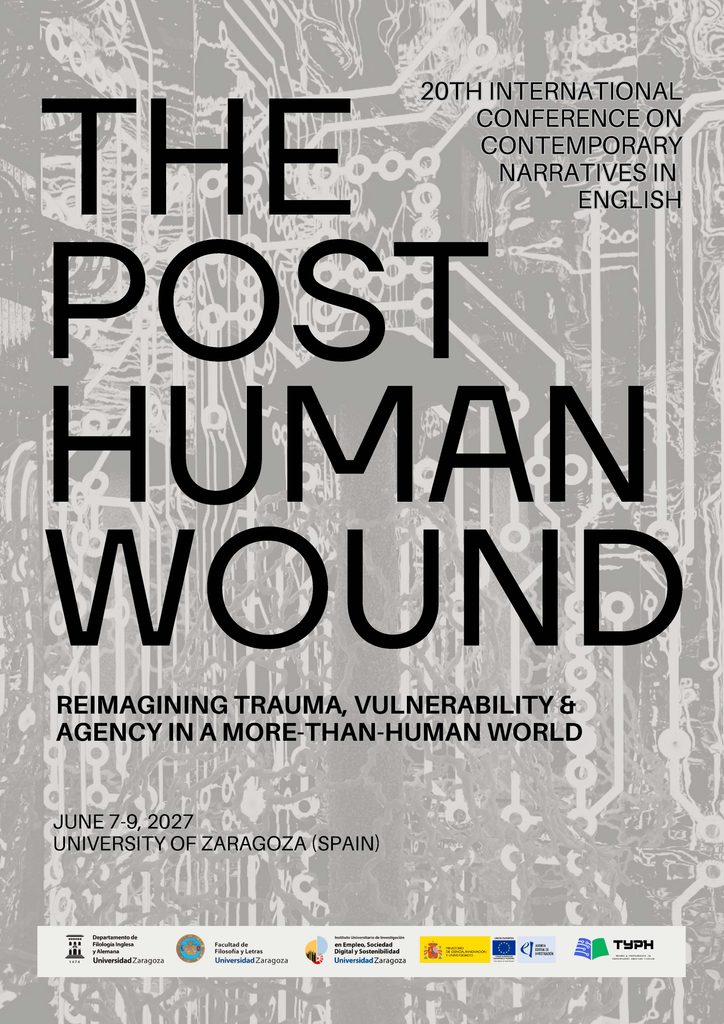
Event organised by “The Posthuman Wound” research group
Venue details: Facultad de Filosofía y Letras, University of Zaragoza (Spain)
Event presentation
The conference explores the convergence of trauma studies and critical posthumanism, focusing on questions of subjectivity, embodiment, agency, vulnerability, relationality, and the unstable boundaries of the human. In the context of the profound technological, ecological, and material transformations of the twenty-first century, we invite contributions that consider how contemporary narratives represent and reimagine trauma, vulnerability, and agency beyond the limits of classical humanism. We welcome papers engaging with contemporary literature, film, television, digital media, and other cultural forms.
We are delighted to have three confirmed plenary speakers:
- Dr. Mark Bould (University of the West of England, Bristol, UK). He is a scholar of science fiction, film, literature, and popular culture, with extensive work on Marxism, postcolonialism, and critical approaches to science fiction and the Anthropocene.
- Dr. Marco Caracciolo (Ghent University, Belgium). His work draws on cognitive science, philosophy of mind, and the environmental humanities to explore the forms of experience afforded by narrative in literary fiction and other media, particularly video games.
- Dr. Ana María Fraile-Marcos (University of Salamanca, Spain). Her research focuses on contemporary English Canadian literature and the ways literature reshapes societal imaginaries through narratives of resilience, gender, indigeneity, diaspora, racialization, and the environment.
Website address
Contact details:  theposthumanwoundconference@gmail.com
CFP
For further details, please check the original call inserted below.
 CFP (para difusión) (1)
(Posted 10 October 2026)
Combating harmful stereotyping: a cross-disciplinary approach.
Host and dates: Université Grenoble Alpes, France | 17-18 June 2027.
Deadline for submissions: 05.01.2027.
Event organised by
- Laure Gardelle (Université de Grenoble Alpes) &
- Sandrine Sorlin (Université de Montpellier Paul-Valéry/IUF)
Event presentation
The full cfp can be accessed on the conference website (see below).
It is well established in research as well as in the social arena that a number of stereotypes are harmful, because they are “preconceived and oversimplified idea[s] of the characteristics which typify a person, situation, etc” (OED 2025, stereotype), and that they lead to biases in the perception of individuals, who are considered on the basis of their membership in a group rather than their individual qualities. Biases may be explicit (“overtly discriminatory beliefs, actions, or institutional policies”), but also implicit, taking the form of “unconscious tacit attitudes and unintentional actions towards a group” (Rutgers 2026) that are likely to be detrimental to the targeted group and life in a peaceful society.
There are now countless initiatives and discussions on the web and on social networks urging to combat stereotypes, whether from international organisations such as UNESCO, the European Commission, or governments, charities, associations, the press, or initiatives in the workplace. In the 14-billion word iWeb corpus of contemporary English, the verb most frequently associated with “stereotypes” is “challenge” (Davies 2018, query “[any verb]+stereotypes”). The focus in the social arena has primarily been on gender, sexual orientation and race/ethnicity, and to a lesser degree, on disability, social class, profession (such as lawyers, nurses, cleaners, farmers), but harmful stereotypes may concern more generally any social group or human category (tourists, students, young people, neighbours, TV viewers, people who read books and so on), or human-related categories (football and more generally sports, dancing, sewing, etc) but they may also concern animals (for instance, perception of sharks as dangerous).
Yet despite these countless initiatives, research has shown how resistant harmful stereotypes can be, and how complex the issue is, relating as it does to contexts, social norms, communities of practice, self-esteem, group identity, language and discourse. A number of causes and solutions have been put forward in a number of fields and disciplines, but there is little dialogue between them. The aim of this conference is to bring together specialists of stereotypes and generalizations across disciplines, especially linguistics, cognitive linguistics, sociolinguistics, discourse analysis, pragmatics, communication studies, philosophy of language, cognitive psychology, social psychology, organizational behaviour, political science, evolutionary psychology, sociology, anthropology.
Keynote speakers
- Catalin Brylla, Principal Lecturer in Film and TV, Bournemouth University
- John Dovidio (to be confirmed), Professor Emeritus of Psychology and Public Health, Yale University
- Adam Hahn, Senior Lecturer in Social Psychology, University of Bath
- Samia Hesni, Associate Professor of Philosophy, Dartmouth College
- Kai Sassenberg, Professor of Psychology at the University of Trier and Director of the Leibniz Institute for Psychology
Submissions
Abstracts of around 300 words (excluding references) should be addressed before 5 January 2027 to:
- Laure Gardelle laure.gardelle@univ-grenoble-alpes.fr
- Sandrine Sorlin sandrine.sorlin@univ-montp3.fr
Timeline
- Deadline for submission: 5 January 2027
- Notification of acceptance: 25 January 2027
Website address
 https://combatstereo.sciencesconf.org/?lang=en
Contact details
(Posted 19 May 2026)
Canada and the logics of the extractive economy: aesthetic, political, legal, historical, economic, and environmental perspectives.
Host and dates: University of Strasbourg | June 23-25.06.2027.
Deadline for submissions: 1 September 2026.
Event organised by:
- Gwen Cressman (U of Strasbourg),
- Léna Ferrié (U of Brest),
- Anne-Sophie Letessier (U Jean Monnet, Saint-Etienne),
- Christine Lorre (U of Caen Normandy),
- Claire Omhovère (U Paul-Valéry, Montpellier)
Event presentation
This conference seeks to explore the logics of extraction from various perspectives, thus encouraging dialogue between the disciplines represented within the Association Française d’Etudes Canadiennes (AFEC). We will examine how the logics of extraction, from forestry to fossil fuels, has reshaped not only material ways of life but also the expectations and preoccupations of contemporary Canadian society. Questions surrounding the effects of the extractive economy, its perceived benefits, its limitations, and the harms it inflicts on environments and communities, resonate across the social sciences, the humanities, and the arts.
The effects of the extractive economy have shaped environmental humanities and worked their way into the arts and literature. The manners in which artists depict the extractive economy and its political stakes, as well as the ways in which their aesthetic choices may legitimize or challenge mining and dependence on fossil fuels, will be analyzed in order to better understand the logics of the energy transition. Beyond its politics of representation, the extractive economy also raises crucial legal, historical, social, and political questions. Canada’s long-term economic history has been marked by the exploitation and export of its natural resources to more developed industrial powers, initially the United Kingdom and today primarily the United States. The extractive sector remains central today, supported by a federal framework that grants provinces authority over land and subsoil resources, as well as by the influence of powerful mining and oil industries closely connected to political elites. Yet, while the Conservative Party embraces Canada’s status as an oil and extractive superpower, the Liberal Party, for the past decade or so, has seemed torn between this economic reality and a narrative aimed at making Canada a model nation in environmental matters. By tracing these historical continuities and their cultural implications, the conference aims to shed light on how extractive logics permeate not only Canada’s artistic practices and material landscapes but also the shifting configurations of the nation in the age of oil.
Keynote speakers:
- Petra Dolata (U. of Calgary)
- Isabella Huberman (U. of British Columbia)
- Lorraine Gilbert (photographer, Ottawa)
Website address
Full CFP available here: colloque annuel – Congrès AFEC 2025
Contact details:
- Anne-Sophie Letessier (anne.sophie.letessier@univ-st-etienne.fr),
- Christine Lorre (christine.lorre@unicaen.fr) and
- Claire Omhovère (claire.omhovere@univ-montp3.fr)
(Posted 20 June 2026)
Teaching and Learning English: Challenges and Perspectives – TeachLEng 2027.
Host and dates: INSPE de l’Académie de Paris – Molitor Campus | 23-25.06.2027.
Deadline for submissions: 18.Oct. 2026.
Event organised by ARDAA (Association for Research in English Language Teaching and Acquisition
Event presentation
We are pleased to announce the second international conference of ARDAA (Association for Research in English Language Teaching and Acquisition), TeachLEng 2027, which will take place on 23, 24, and 25 June 2027 at the INSPE de l’Académie de Paris – Molitor Campus / Sorbonne Université.
This conference will focus on the following theme: Teaching and Learning English: Challenges and Perspectives. With Dr. Alex Boulton, Dr. Wander Lowie, and Dr. Peter Ives among our plenary speakers, the 2027 edition promises to be particularly stimulating. The Call for Papers is available on the dedicated website
( https://ardaa2027.sciencesconf.org/?lang=en ),
and the deadline for submission is October 18, 2026. We warmly invite you to submit a proposal and to participate in this scientific event dedicated to research in English language teaching and acquisition.
Website address https://ardaa2027.sciencesconf.org/?lang=en
Contact details Lindsey Paek (lindsey.paek@univ-lorraine.fr) On behalf of the Organizing Committee
CFP
For further details, please check the original call inserted below.
(Posted 5 October 2026)