Imagining Railways from 1900 to the Present: Places, People, Infrastructures, Texts – a RAILIMAGE Conference.
Host and dates: Åbo Akademi University, Turku, Finland. 1-3 April 2027.
Deadline for submissions: 30 September 2026.
Event presentation
The project ‘Twentieth-Century Railway Imaginations: Building the Mobility and Infrastructural Humanities’ (RAILIMAGE) invites scholars from all backgrounds to submit paper proposals for its 2027 conference. We also warmly encourage early-career researchers to apply.
The conference takes a diachronic view of railways focused on how people have experienced and imagined them, their spaces, and the experiences that railways generated in almost every global region during the long twentieth century. We welcome submissions from researchers in a multiplicity of disciplines, including literary and cultural studies, critical realist studies, human geography, political science, visual studies, mobility humanities, transport history, cultural history and more. A core contribution made by the project consists in recentring the long twentieth century in humanistic railway studies. This was an era when railways were the primary instrument of social change brought about by mobility. However, its transformative importance has often been overlooked in railway studies focused on the novelty of the mode in the nineteenth century and its potential to deliver sustainable long-distance transport in the twenty-first century.
The conference will feature three keynote speakers as well as an early-career keynote talk (to be announced).
Themes to be explored include, but are not limited to, the following:
- the railway and (literary and/or artistic) form
- the railway as infrastructure
- gender and sexual identity
- (post)colonial perspectives
- railway and war
- experiences of long-distance travel
- experiences of commuting
- the experience of railway work (labour, bureaucracy)
- spaces of the railway
- railway people
- railway heritage and memory politics
- railway and care
- railway future
- railways, landscape and the environment
- comparisons between literary and visual depictions of the railway
If you are interested, please send a proposal of max. 500 words to the organizers no later than 30 September 2026. All abstracts should include a title as well as the names, affiliations and email addresses of all authors. Please also provide a short bio (max. 100 words) for each author.
Important Dates
- 30 September 2026 Deadline for submission of paper proposals
- 30 November 2026 Notification of paper acceptance
- 31 January 2027 Registration closes
- 1–3 April 2027 Conference
Practical Information
- The conference is an in-person event only.
- The conference language is English.
- Artists requiring specific infrastructure or equipment are encouraged to get in touch with us regarding their needs before submitting an application.
- More information is available on the conference website: blogs2.abo.fi/railimage
Contact Details
Please submit your paper proposal to  railimage.abo@gmail.com
If you have any questions about the conference, please do not hesitate to get in touch.
- Niral Joshi, Åbo Akademi University, Finland
- Jason Finch, Åbo Akademi University, Finland ( jason.finch@abo.fi)
- Adam Borch, Åbo Akademi University, Finland
- Zeynep Correia, Åbo Akademi University, Finland
CFP
For further details, please check the original call inserted below.
 CfP_RAILIMAGE Conference 2027
(Posted 7 March 2026)
LAPASEC 2027: Industry and Idleness: Labour, Luxury and the British Empire in the Long Eighteenth Century.
Host and dates: University of Duisburg-Essen | 2-4 April 2027.
Deadline for submissions: 20 May 2026.
Event presentation
LAPASEC 2027. The Landau-Paris Symposia on the Eighteenth Century (LAPASEC) series focuses on the literature and culture of the British Isles of the period, but it is also open to topics relating to the British colonies, France, Germany, and further afield. Attendance is free, and for those in the early stages of their academic careers, we are seeking to subsidise conference costs. We invite 20-minute papers in English, French or German, with a discussion time of 10 minutes.
Our conference aims at bringing together a diverse range of approaches and methodologies. Possible fields of research include literature, the performing arts, political and intellectual history, gender studies, philosophy, minority studies, the visual arts, music, architecture, religion, law and economics amongst others.
Website address
 https://www.uni-due.de/anglistik/english_literary_and_cultural_studies/lapasec.php
Contact details
CFP
For further details, please check the original call inserted below.
(Posted 29 April 2026)
FEMINANIMALS: Representations of Women and/as Animals in Literature, Arts, and Other Media.
Host and dates: Oriel College, University of Oxford | 14-16 April 2027.
Deadline for submissions: 15 July 2026.
Event organised by:
- Dr Frances Clemente (University of Oxford),
- Dr Greta Colombani (independent scholar),
- Dr Cécile Bishop (University of Oxford)
Venue details: Oriel College, University of Oxford
Event presentation
FEMINANIMALS is a three-day international conference investigating representations of women as non-human animals and of the relationship between women and non-human animals in literature, arts, and other media across languages, from medieval to contemporary times.
Across time and space, literature, arts, and other media have been pervaded by portrayals of women as/and animals, from the moralistic, religiously informed intertwining of gender and species in medieval bestiaries to the countless retellings of the legend of the half-human half-snake Melusine in texts like Jean d’Arras’s Mélusine (ca. 1393), from the woman-animal erotic unions and shapeshifting in the late seventeenth- and early eighteenth-century supernatural tales Liaozhai zhiyi by Pu Songling to the numerous poems dedicated to wild, exploited, or domesticated animals by Romantic and Victorian women authors, from Odette’s transformation into a swan in Pyotr Ilyich Tchaikovsky’s ballet Swan Lake (1877) to visual depictions of woman-animal entanglements in the surrealist works of Leonora Carrington who identified as a “female human animal”. In more recent times, one could mention Clarice Lispector’s novel A paixão segundo G.H. (1964), Marie Darrieussecq’s satirical tale of a woman’s metamorphosis into a female pig in Truismes (1996), Nnedi Okorafor’s Africanfuturist speculative novel Who Fears Death (2010), and Athina Rachel Tsangari’s films Attenberg (2010) and The Capsule (2012). The conference will examine what these pervasive representations of women as/and animals in different cultures and historical periods can tell us about shifting notions of gender and species, the fraught line between humanity and animality, and the entwined practices of domination and othering to which women and animals have been subjected.
We encourage proposals considering works belonging to different media and genres, focusing on canonical as well as noncanonical authors and artists, and dialoguing with diverse theoretical and methodological approaches, such as human-animal studies, posthumanist studies, new materialism studies, ecofeminist studies, animal studies, critical animal studies, animality studies, gender studies, critical race and postcolonial studies, queer studies, psychoanalytic and post-structural studies, affect theory, and other relevant fields of inquiry. Papers may explore topics including, but not limited to: women-animals metamorphoses; women-animals hybrids; women, animals, and the body; women, animals, and sexuality; women, animals, and gender; women, animals, and race; women, animals, and class; women, animals, and motherhood; metaphors of women as animals; women, animals, and language; kinship between women and animals; women, animals, and ethics and aesthetics of care; women, animals, and the environmental crisis; women, animals, and science; women, animals, and spirituality; women, animals, and folklore; women writers/artists and animals; trans women and animals; women, animals, and the male gaze.
Please note that the conference will take place in person in Oxford with no possibility for hybrid participation. There will be no conference fee. All presentations should be in English and last no longer than 20 minutes. Proposals, including title, abstract (250 words max), and short bio (150 words max), must be submitted via email in a single Word document to
frances.clemente@oriel.ox.ac.uk and greta.colombani@gmail.com by 15 July 2026.
Notification of acceptance will be sent by 30 July 2026. Please feel free to contact the organisers Dr Fanny Clemente and Dr Greta Colombani at any point for inquiries and further information.
Keynote speakers:
- Prof Chloë Taylor (University of Alberta) and
- Dr Kaori Nagai (University of Kent)
Roundtable with Queer Kinship Network led by Prof Charlotte Ross (University of Oxford)
Website address
Contact details
CFP
For further details, please check the original call inserted below.
(Posted 13 April 2026)
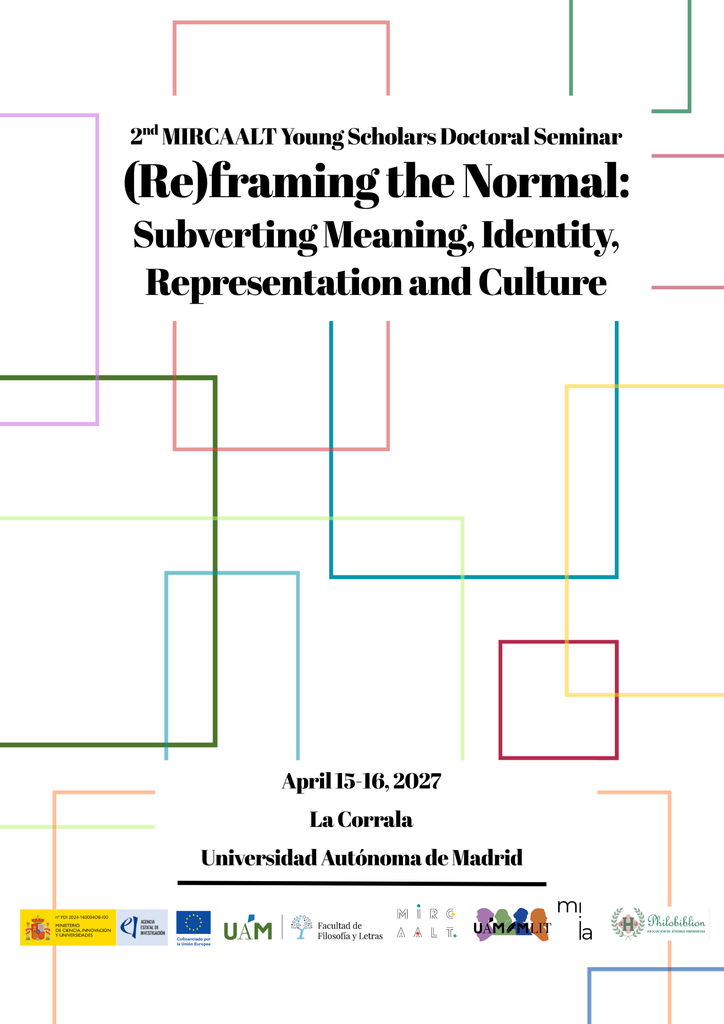
2nd MIRCAALT Young Scholars Seminar: “(Re)framing the Normal: Transgressing Meaning, Identity, Representation and Culture in Literature”.
Host and dates: Universidad Autónoma de Madrid | 15-16 April 2027.
Deadline for submissions: 15 January 2027.
Venue details:
Centro Cultural La Corrala
C/ Carlos Arniches 3 y 5
28005 – Madrid
Event presentation
Accustomed as the world is to questioning traditional terms and definitions, people have honored this creative drive and they have continuously revised what “normal” stands for and produced renewed meanings of it. Forced by catastrophes — the 9/11, the COVID pandemic, the Russian invasion of Ukraine — by socio-political movements — the MeToo, the Black Lives Matter, No More Stolen Sisters — or even by literary currents — Postmodernism, Transculturalism, Ecocriticism — “normal” has never stayed a stable category. This ceaseless endeavour to reconstruct the frames containing normalcy, however, has intensified its force in the past few years. In a period of history where the rise of conservationism claims for stricter lines of definition, the MIRCAALT Group emphasizes the urgency to keep re-questioning to a deep level what for centuries was considered fixed and indisputable.
In particular, this seminar incorporates as one of its main objectives the relocation of power. Although “normal” has traditionally belonged to privileged groups’ discourses and “those in positions of power continually try to erase subject-positions outside of what is viewed as culturally legitimate (and consequently normal and viable), people who live those subject-positions continue to attempt to articulate them” (Cromwell, “Queering the Binaries Transsituated Identities, Bodies, and Sexualities” 509-519). Thus, “reframing the normal” is interpreted as the communal effort to reinscribe normalcy’s content and limits, but also the locus from which it is crafted. In this sense, this seminar emerges as an opportunity for early career scholars to substantially explore the so-called “normal” and its workings. Through this exploration, scholars may reimagine its definition, along with the subjects in charge of their production and its degree of desirability in a world rooted in the multiplicity and mutability of its nature.
The 2nd MIRCAALT seminar is conceived, then, as the frame for rethinking the normal in a moment where the concept has been diffused, perhaps to its advantage. Indeed, as Judith Butler claims, “the question of what it is to be outside the norm poses a paradox for thinking, for if the norm renders the social field intelligible and normalizes that field for us, then being outside the norm is in some sense being defined still in relation to it” (Undoing Gender 42). These ““frames” that work to differentiate the lives we can apprehend from those we cannot […] generate specific ontologies of the subject” (Butler, Frames of War 3-4) but as “norms” and “frames” they can be reworked. Through the contribution of young scholars from different fields of research — queer theory, border studies, indigenous epistemologies, etc. — the “normal” is contested and resisted to the extent that analyses queerly fail at replicating the same normative conventions and instead turn “on the impossible, the improbable, the unlikely, and the unremarkable. [They] quietly lose[…], and in losing [they] imagine[…] other goals for life, for love, for art, and for being” (Hallberstam, The Queer Art of Failure 88).
Following this year’s topical focus, suggested topics for this seminar include but are not limited to:
- Border studies: (Re)frames of limits and marginal zones and beings, understood in the broadest sense of both geopolitics and identity issues. This includes border zones, migration literature, borderlands, human limits, and any analysis that focuses on what sits at the edges.
- Queer theory: From the perspective of “reframing the normal,” queer studies questions how society defines and enforces what is considered “normal” in terms of gender and sexuality. As Michael Warner argues, “queer” reveals how the normal can become “a site of violence” rather than “simple intolerance,” gaining its “critical edge” when it defines itself “against the normal rather than the heterosexual” (Fear of a Queer Planet xxvi). In this sense, queer studies reframes the “normal” by exposing how it is produced, maintained, and used to marginalize those who do not conform to it.
- Mothering studies: Literary reconsiderations of maternal identities, mothering practices and family structures in all its variations, including all forms of subversiveness connected to gender, sex, sexuality, race, class, religion, culture, etc.
- Body studies: Perception of normal and not normal human bodies, from both the inside and the outside. This can include the corporal abject, reproductive rights, disability studies, medical humanities, biopolitics and necropower governing bodies, and gender issues.
- Spectral criticism: Representations of the ghost linked to the Gothic, the Uncanny and/or Hauntology, as a literary trope capable of addressing various forms of absent presence or spectral agency, for example, the legacy of structural violence, the manifestation of trauma and (post)memory, and the creation and exclusion of otherness.
- Indigenous studies: Indigenous epistemologies, storytelling traditions, and literary representations that challenge colonial and Eurocentric frameworks of normalcy, sovereignty, identity, belonging, and land relations.
- Poetry studies: Poetic forms as sites of resistance and formal innovation, exploring how lyric voice, syntax, rhythms, and aesthetics interrogate, disrupt, and reframe normalcy in cultural, political, ecological, or spatial approaches in poetry (among others).
- Spatial studies: Literary, cultural, and sociological perspectives on the ways in which space is constructed, represented, and experienced. Explorations of how our understanding of space is shaped by social and cultural structures, and how spaces in turn influence experiences of belonging, exclusion, identity, and normality.
- Critical identity studies: Literary and cultural approaches to the ways in which identities are constructed, experienced, and negotiated. This line focuses on how identities become shaped by particular social and cultural contexts, and how literature can question the boundaries between normative and marginalised forms of identity.
- Ecocriticism: Literary works that, from an ecocritical, ecofeminist, and/or posthumanist perspective, challenge the ways of life presented as natural or normal in the context of the Anthropocene and the Capitalocene, as well as the hierarchies that shape the relationships between bodies, territories, and species.
Abstracts should be around 300 words, and they should include 3-4 keywords and a short bionote. Papers can be delivered in English or in Spanish and MLA citation style is recommended. Please submit proposals through the documentation > abstract submission tab on our website. The deadline for submission is January 15. Notifications of acceptance will be sent out by the end of January 2027.
Website address
https://eventos.uam.es/go/reframingmircaalt
Contact details
CFP
For further details, please check the original call inserted below.
(Posted 17 October 2026)
Culture and Cognition in Language 5: Dynamic Aspects of Meaning Construction.
Host and dates: Institute of English Studies, University of Rzeszów, Poland | 27-28 April 2027.
Deadline for submissions: Abstract submission deadline: 15 September 2026. Notification of acceptance: 15 October 2026.
Venue details: Hotel Skalny Spa, ul. Zdrojowa 11, 38-610 Polańczyk (bus transportation from Rzeszów to Polańczyk and back provided by the organisers).
Event presentation
Meaning is not a static property of words or sentences but an emergent, context-sensitive outcome of cognitive and communicative processes. Historical semantics provides an essential backdrop for understanding how meaning emerges and transforms across time, and how changes in meaning correlate with shifts in conceptual organization and communicative practice. Rather than treating semantic change as a sequence of isolated shifts, contemporary approaches emphasize its dynamic, cognitively motivated character.
Yet diachronic and synchronic variation are inextricably connected, for processes such as metaphorization, metonymization, broadening, narrowing, and shifts in evaluative meaning can be seen as long-term manifestations of the same conceptual mechanisms that shape meaning in everyday discourse, while lexical variation may be regarded as the result of an interaction between semasiological and onomasiological changes.
Dynamic approaches to meaning construction foreground the idea that “meaning construction is grounded in the principles of cognitive modeling”, highlighting the role of conceptual integration, frame shifting, perspective taking, metaphor, metonymy, and other cognitive mechanisms in shaping how speakers produce and interpret meaning in real time.
Building on the rich traditions of Cognitive Linguistics, Construction Grammar, and Discourse Analysis, this year’s edition invites contributions that investigate the dynamic, situated, and often unpredictable nature of meaning-making across a range of linguistic and multimodal contexts.
With the above in mind, we particularly welcome submissions addressing topics such as:
- Diachronic aspects of meaning
- The interplay between synchrony and diachrony
- Conceptual integration and blending
- Metaphor and metonymy in discourse
- Construction Grammar and constructional meaning
- Frame semantics and frame-shifting
- Perspective, subjectivity, and viewpoint
- Embodiment and situated meaning
- Dynamic meaning in multimodal communication
- Meaning construction in interaction and conversation
- Creative language use: humour, irony, and non-literal meaning
- Cross-linguistic and cross-cultural variation in meaning construction
- Computational and corpus-based approaches to dynamic meaning
While we will especially appreciate presentations aligned with the theme of the conference and the proposed topics, we are open to papers on all topics discussing language from a cultural and cognitive perspective.
Research areas especially welcome:
- Cognitive linguistics
- Cultural linguistics
- Semantics and pragmatics
- Sociolinguistics
- Psycholinguistics
- Construction Grammar
- Discourse analysis
- Multimodality and semiotics
- Philosophy of language
- Rhetoric and argumentation
- Contact linguistics
Confirmed Keynote Speakers:
- Prof. Dirk Geeraerts (University of Leuven)
- Prof. Francisco José Ruiz de Mendoza Ibáñez (University of La Rioja)
- Prof. Kathryn Allan (University College London)
Website address
https://www.ur.edu.pl/pl/wydzialy/wydzial-filologiczny/nauka/konferencje/ccl-5
Contact details
CFP
(Posted 6 May 2026)