‘A Breeze in God’: The Spirituality of Music and Song.
Host and dates: Parthenope University, Naples). 11-12 September 2026.
Deadline for submissions: 30 April 2026.
Event organised by: Raffaella Antinucci (Parthenope University, Naples) and Adrian Grafe (Université d’Artois)
Venue details: Parthenope University, Naples, Italy
Event presentation
Why is spirituality so closely linked to music and song? Composer Philip Glass has said of the chant of Buddhist monks that it is ‘a tradition where the musical and spiritual inheritances of the community are really identical’ (Schaefer 14). One might go even further and say, with the Rilke of the Sonnets to Orpheus, that ‘Singing is Being’. With contemporary advances in the neurosciences, the growing scientific and medical interest in music therapy, and the acknowledgement of the role of music and song in many spiritualities and faith expressions, as well as ways in which religious allusions and references can be harnessed to otherwise secular forms of art, it would seem timely to interrogate such phenomena from various scientific and humanistic perspectives and theoretical standpoints. Can non-spiritual music and song be considered as granting access to spirituality, as a valid form of knock-knock-knocking on heaven’s door, and what kind of ‘heaven’ would that be?
The organisers would love to welcome researchers, musicians, and people who are both researchers and musicians. Contributions may take the form of traditional academic papers, musical performances, creative criticism, or blendings of these approaches. With no pretence to exhaustiveness, and along with the above remarks, presentations might focus on:
- The phenomenology of spiritual experience linked either to composing music, listening to music, alone or as audience member, or to the playing of music (for example, musicians’ accounts of spiritual experiences they may have had while performing)
- Questions of intention and reception: if the intention behind a work is spiritual, how far is it received as such – how far should it be received as such – by an auditor or an audience?
- Monastic singing, including Buddhist and Christian, as an intrinsic part of spiritual life
- Sacred choral music in different ecclesial traditions and communities
- Spirituals – the religious songs of black people in America, but also white spirituals; and musical compositions based on spirituals such as those of R. Nathaniel Dett (1882–1943)
- The nature of religious poetry inspired by music and musicians, a prime example being G. M. Hopkins’s ‘Henry Purcell’
- Musical settings of sacred texts and religious poetry
- The phenomenon of American Christian rock music (Lauren Daigle, Matt Maher, Rich Mullins), and the question of cross-over into mainstream genres and reception
- Music associated, rightly or wrongly, with so-called ‘New Age’ spirituality (cf Einaudi’s ‘Divenire’)
- Music and song as an experience of time, timeless and eternity, or of ‘infinite space’
- Music, song, faith and doubt, religious or otherwise
- Possible anti-spirituality in certain pieces or types of music (e.g. some kinds of heavy metal)
- Spiritual interpretations of non-spiritual works
- The role of silence in music and spirituality (e.g. John Cage’s 4’ 33’’)
- Music as ritual or liturgical action (not merely as accompaniment to worship but as a spiritual act in itself)
- Spirituality and digital music
- Spiritual longing in secular music
- The spiritual dimensions of improvisation, especially in jazz, gospel, or spontaneous worship music
- etc.
Submissions
Please send 150-word proposals for 20-minute presentations in English, accompanied by a brief biobiblio, to
- Raffaella Antinucci
 raffaella.antinucci@uniparthenope.it and
 - Adrian Grafe adrian.grafe@univ-artois.fr
by April 30th 2026.
Notification of acceptance by May 10th 2026.
CFP
For further details, please check the event original call inserted below.
 CFP Spirituality Music and Song Parthenope 10-11 SEPTEMBER 2026
(Posted 5 February 2026)
Textual Embodiments: Remediating Meaning Across the Disciplines.
Host and dates: Rome Link Campus University | 11-12 September 2026.
Deadline for submissions: 1 June 2026.
Event organised by:
- Link Campus University,
- AIA, Associazione Italiana di Anglistica/Italian Association for the study of English
Venue details: Rome Link Campus University
Event presentation
Eighteenth-century philology, as the science of editing and interpreting texts, while evolving in compartmentalised disciplines within the modern university curricula, formalised the analysis of written and visual works according to a shared methodology. Throughout its long history, philology has gone through important changes in the understanding of each component of the hermeneutic circle: author, text and reader. All periods in which philology was formalised as a discipline, i.e. the Hellenistic period, the Renaissance, and the second half of the eighteenth century in Göttingen have elaborated a methodology in response to important changes in the material production and dissemination of texts. A focus on the technology of writing, the critical evaluation of the manuscript tradition, and the manufacturing of printed books and critical editions have all accompanied its evolution in response to the groundbreaking technological innovations of the time mediating culture transfer. As we are undergoing a new technological revolution with the production and dissemination of digital texts, this conference shall focus on the question of mediality in the production and circulation of texts, artistic works and performances from all periods. What is the role of each medium (writing, printing, digital textuality, artistic practice, embodied performance) in shaping communication strategies, literary and journalistic genres, as well as interactions and synergies with other media accompanying the written text? Which communities are involved in these exchanges? The topics proposed shall ideally contribute to a transhistorical, intermedial and interdisciplinary reflection.
Among the possible topics topics:
- the circulation of manuscript texts (including collections of poems, libri amicorum, albums, diaries, etc.).
- text/image dynamics from antiquity to the contemporary period.
- genres of periodical fiction and nonfiction.
- digital editions of manuscript texts.
- the evolving structures of the English language in relation to specific media.
- the history of reading, writing and publishing.
- the mediators of culture transfer (printers, booksellers, illustrators, colonial agents).
- serialization (of printed texts and visual narratives).
- the evolving media landscape through the lens of aesthetics.
- performativity in conceptual art, experimental theatre, modern dance.
- literary narratives foregrounding specific media.
- selfreflexive transmedial adaptation studies.
Website address
 https://www.unilink.it/ateneo/chisiamo
Contact details
- Alberto Gabriele a.gabriele@unilink.it and
- Carlo M. Bajetta at c.bajetta@univda.it
(Posted 22 April 2026)
Fissures: Gender and Political Crisis.
Host and dates: Pembroke College, Cambridge | 17-18 September 2026.
Deadline for submissions: 16 January 2026.
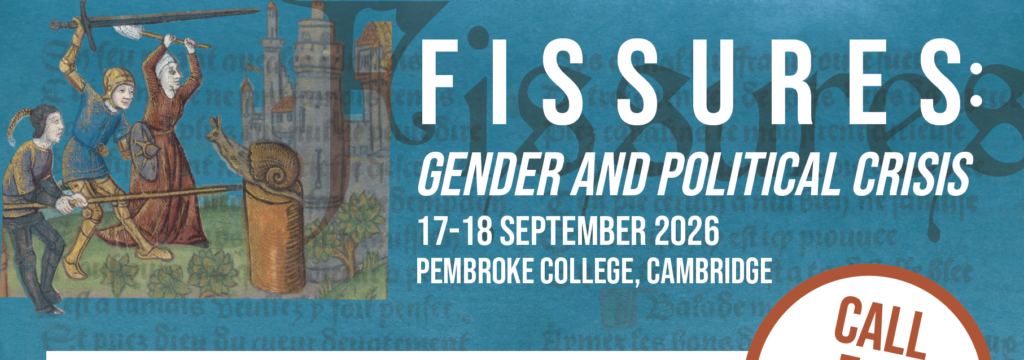
Event presentation
Gendered work on medieval popular politics has ended to revolve around the exceptional. This workshop explores how studies of gender can reconfigure discourses of medieval political community. We ask how attending to gendered bodies and identities might help us better understand the fissures in political culture in medieval Europe. Marking, for example, women’s participation as either absent or rare confines their involvement to the historical margins. How did literary as well as non- literary texts from various genres, ranging from the thirteenth to the sixteenth centuries, engage with gendered political action? How did ideas of gender stabilise or destabilise political performances?
We invite abstracts for 25-minute papers, as well as expressions of interest for participation. We welcome papers with a historical, literary, or interdisciplinary focus. Potential topics could include but are not limited to:
- Frameworks for understanding non-normative gender expressions in political spaces.
- Studies of politics at the intersection of gendered, queer, or trans methodologies.
- Histories of masculinities in the political community.
- Emotion and/or Affect
- Weaponized/defensive gender
- Manoeuvring bodies through political crisis
- Inclusion and exclusion
- Different sites of political discourse, such as domestic and non-violent conflict.
- Collectively, the papers will interrogate the role of gender in political discourse.
Contact details
- Abbie Fray abigail.fray@unibe.ch
- Alice Raw ar889@cam.ac.uk
CFP
For further details, please check the event original call inserted below.
(Posted 18 December 2025)
Stories and Histories of Power.
Host and dates: ERIBIA, Université de Caen Normandie. 24-25 September 2026.
Deadline for submissions: 15 May 2026.
Event presentation
Confirmed Keynote speaker : Peter Boxall
Based on the premise that any account is the result of a re-ordered selection in facts which is the mark of the power of the author and/or the institution or cultural group they stand for., this conference will examine factual and fictional narratives of power in the English-speaking world.
Biographies, biofictions and biopics tell a rise or an attitude to power (a higher position of control and exertion of power politically of culturally) and historical fiction feeds and orientates the memory of power. The theme of power is rooted in authority, but also in everyday life. In many novels and short stories, it lends itself to specific representations, such as political figures, religious leaders or heads of families. These authority figures are often allegories on the paradigmatic axis. All representations of power in literature can be discussed here. We will also consider the shift in authors and subjects of stories and histories of power, focusing both on the process and the result of marginalisation and invisibilisation of non-dominant groups/minorities. How is this shift operated in fiction and how is the reader/viewer led to sympathise with it?
In a historical or cultural studies perspective, we are invited to interrogate the ways power is constructed, legitimized, or contested. Power tries to engage historians in producing such discourses as will bolster authority. Dominant powers seek to marginalize and exclude dissident voices, though counter-narratives will emerge to challenge established social and political orders. Through narrative practices such as public speeches and their scenography, biographies and autobiographies, power constructs and projects itself. Political actors will use language in the broad sense to bring closer to the people the abstract institutions that rule their lives within given social structures, whether they seek to strengthen or overthrow such institutions. Polities rest upon foundational myths transmitted, revisited or reappropriated through public festivals, media narratives and cultural accounts. Studying these various aspects will be an investigation of how authority is (re)configured, (re)modelled or resisted.
Besides individual proposals as usual, we also welcome dual proposals, with 2 related talks: the same topic considered in two different geographic areas, or in two different approaches (fiction/history, history/visual arts…), a foundational myth at two distinct times, two consecutive events… Once you have agreed with a colleague, send us your individual abstracts and bio notes in a single document under a joint title. Feel free to contact us if you have any questions.
Contact details
- Bertrand Cardin (bertrand.cardin@unicaen.fr)
- Anne-Catherine de Bouvier (anne-catherine.debouvier@unicaen.fr)
- Taoufik Djebali (taoufik.djebali@unicaen.fr)
- Armelle Parey (armelle.parey@unicaen.fr)
CFP
For further details, please check the event original call inserted below.
(Posted 16 February 2026)
International Conference on Literatures, Languages, Cultures, and Teaching English in a Changing World.
Host and dates: University of Prešov, Slovakia. 24-25 September 2026.
Deadline for submissions: 21 May 2026.
Event organised by University of Prešov Campus, 17. Novembra 1, 08001 Prešov, Slovakia.
Event presentation
The conference seeks to:
- Promote critical reflection on contemporary developments in English-language literary and cultural studies
- Encourage dialogue between theoretical, historical, and interdisciplinary approaches to language and literature
- Explore the intersections between linguistic theory, pedagogy, translation, and cultural analysis
- Foster interdisciplinary and comparative research across national, linguistic, and cultural boundaries
- Support scholarly exchange between established academics and early-career researchers
Conference Sections and Thematic Areas
Scholars are invited to submit proposals addressing, but not limited to, the following areas:
Literatures of the English-Speaking Countries
- British, American, Irish, Canadian, Australian, and other Anglophone literatures
- Postcolonial, decolonial, and transnational literary studies
- Ethnic, minority, Indigenous, and diasporic literatures
- Contemporary fiction, poetry, and drama in English
- Literary theory, criticism, and historiography
- Intermediality and interdisciplinary literary research
- Artificial Intelligence, Technology, and Literature
- Place, Region, and Space in Anglophone Literatures
Linguistics
- Theoretical and descriptive linguistics
- Applied linguistics and language use
- Sociolinguistics, pragmatics, and discourse analysis
- Corpus linguistics and digital approaches to language study
- English as a global, international, and pluricentric language
- Language variation, change, and contact
- Artificial Intelligence and linguistics
Methodology of Teaching English
- English as a Foreign Language (EFL) and English Language Teaching (ELT)
- Curriculum design, syllabus development, and assessment
- Innovative pedagogical approaches and classroom practices
- Digital tools, AI, and blended learning in English education
- Teacher training, professional development, and reflective practice
- Intercultural communication and competence in language teaching
Cultural Studies
- Cultural identities, memory, and representation
- Media, popular culture, and digital cultures
- Gender studies, ethnicity, and power relations
- Globalization, mobility, and transnational cultural flows
- Cultural theory and interdisciplinary approaches
- Artificial Intelligence and cultural contexts
Translation Studies
- Literary and non-literary translation
- Translation theory, history, and criticism
- Cultural, ideological, and ethical dimensions of translation
- Audiovisual, digital, and multimedia translation
- Translation pedagogy and translator training
Website address
Contact details:
Prof. PhDr. Jaroslav Kušnír jaroslav.kusnir@unipo.sk
(Posted 9 March 2026)
International Academic Conference “Nature and Civilization in Anglophone and Russian Literature and Culture”.
Host and dates: Moscow Pedagogical State University; Nizhny Novgorod State Linguistics University N.A. Dobrolyubov | 24-26 September 2026.
Deadline for submissions: 20 August 2026.
Venue: Nizhny Novgorod State Linguistics University named after N.A. Dobrolyubov (31a Minina St., Nizhny Novgorod)
Format: Hybrid (in-person and online)
Event presentation
Main Topics of the Conference:
- The Functions of Landscape in Creative Works of Fiction across Different Eras and Styles.
- The Relationship between Humans and Nature as a Cultural Code: Values, Symbols, Meanings, Religious and Philosophical Foundations, and the Philosophical-religious Pursuits of Different Epochs.
- Tradition and Innovation in Literary Works on Nature and Civilization. Artistic Discoveries in Literature Addressing the Theme of Nature and the Problem of the Civilization–Human–Nature Relationship.
- The Language, Speech, and Silence of Nature: Modes of Representation and Ways of Artistic Interpretation. An Author’s Style and the Means of Depicting Nature in Literature and Other Art Forms.
- The Symbolism and Philosophy of Urban, Natural, and Emotional-spiritual Landscape in Fiction and in Literary Nonfiction (Essays, Memoirs, Diaries, Correspondence, Travel Notes).
- The Didactic Potential of English-language Texts about Nature in the Teaching of English Language and Literature.
- Humans and civilization as a fragment of the national conceptosphere. Features of its linguistic and artistic representation.
The conference welcomes specialists, University faculty members, postgraduate students, master’s students, as well as research methodologists who have scholarly works on the topics outlined in the conference themes.
To participate in the conference, please send your application (application form attached), including the title of your paper and a brief abstract, to the Organizing Committee by e-mail lucia-photinia@mail.ru until August 20, 2026. Please mark your message: “To the Organizing Committee of the RATEL Conference”.
Contact person: Doctor of Philology, Associate Professor Koroleva Svetlana Borisovna. Tel.: +7 (908) 2307798.
E-mail: svetlakor0808@gmail.com
CFP
For further details, please check the original call and the application form inserted below.
 APPLICATION FORM – Nature and Civilization Conference
(Posted 22 July 2026)