Languaging Crises Conference (LanCris).
Host and dates: University of Helsinki, Finland. 4–5 March 2026.
Deadline for submissions: 31 October 2025.
Event presentation
The Languaging Crises conference focuses on the ways in which language is used and abused in crisis situations or the ways in which various crises are dealt with in different texts. In particular, more research is needed on how the language used during small- and large-scale crises is targeted at, and received by, different demographic subsets within heterogeneous societies, and whether effective communication requires a messaging strategy that takes those subsets into account in different ways.
The presentation proposals can approach communication and language use during crises from various perspectives, ranging from linguistics and language studies to discourse analysis, communication and social studies. They can also deal with both diachronic and synchronic communication about global and local crises and examine texts by public figures, the media, organisations or individuals. The crises investigated may include, but are not limited to, the following:
- health crises, accidents and traumas
- wars, conflicts and violence
- natural disasters and environmental crises
- economic/financial/political crises
- organisational crises and reputation crises
- inter/personal crises and life changes
- hateful and impolite situations
The confirmed keynote speakers are
- Tony McEnery (Lancaster University),
- Merja Koskela (University of Vaasa),
- Dario Del Fante (University of Ferrara),
- Heini Hakosalo (University of Oulu).
Contact details: lancris@helsinki.fi
Website and CFP
For further details, please check the event website and original call inserted below.
 https://blogs.helsinki.fi/languaging-crises/lancris-conference/
 Call for Papers-lancris
(Posted 8 September 2026)
Shakespeare in a Polarized World.
Host and dates: WBO, Université Libre de Bruxelles. Brussels. 6 – 9 March 2026.
Deadline for submissions: 31 August 2025.
Organisers:
- Waseda University (Tokyo),
- University of Birmingham’s Shakespeare Institute (Stratford-upon-Avon),
- Université Libre de Bruxelles.
The conference’s aim is to explore the raison d’être of literature and the arts in a world of increasing political and cultural divisions.
The focus of the conference will be on how Shakespeare and the study of Shakespeare might contribute to mitigating the present political and social divisions that threaten to undermine the basic principles of a democratic society: divisions that range from cancel culture and TERF activism, the vilification of immigrants and climate change denial, to geopolitical struggles around the world. It takes as its starting point Richard Rorty’s argument that literary texts are “narratives which connect the present with the past, on the one hand, and with utopian futures, on the other,” promoting human solidarity. The aim of the conference is to identify shared views and values within the palimpsestic nature of the works, the widely-varied discussions and interpretations they have invited, and the complex views that unfold in the works themselves, as points of solidarity and keys to overcoming the polarization in the world today.
Possible topics of discussion could include:
- Engagement with contentious aspects of the text through digital and other forms of media
- Theater practices that encourage the audience to engage with the text and one another
- The work of editors in dealing with politically contentious aspects of a text
- Surveys of Shakespeare criticism that identify common threads of ideas in antithetical discussions
- Politically or culturally divisive issues added to the works through translation
- Adaptations of the works that address the issue of polarization
Prospective keynote speakers include:
- Professor Nataliya Torkut (National University, Zaporizhzhia; Ukrainian Shakespeare Centre) and
- Professor Michael Dobson (Shakespeare Institute, the University of Birmingham).
Registration and proposals
Please register here. You will then receive a message with an email address to which proposals should be sent by noon (JST) on 31 August 2025. You will be notified of results of the selection by 30 September 2025.
Proposals should include 1) the name of the author, with affiliation, and email address, 2) a 100-word biographical note 3) the title of the proposed paper, and 4) a 300-word abstract. Selected papers will be organized into panels of three 20-minute papers each with a 30-minute Q&A at the end of each panel.
Inquiries
Please send inquiries here or at jean-louis.moortgat@ulb.be
Conference websites
- For more information, please visit: SHAKESPEARE IN A POLARIZED WORLD – WBO, Université Libre de Bruxelles 6 – 9 March 2026
- For details and the latest updates on the conference: Waseda University Brussels Office
(Posted 2 July 2025)
Authors as Characters in Fiction, Film and Graphic Narratives.
Host and dates: Université de Lorraine, Nancy (France). 12-13 March 2026.
Deadline for submissions: 1 September 2025.
Venue details: 91 Avenue de la Libération, Université de Lorraine, Nancy (France).
Event description
The aim of this international and interdisciplinary conference is to understand the fetishisation of English-speaking canonical authors (such as William Shakespeare, Virginia Woolf, Jane Austen, the Brontë sisters, Henry James, Charles Dickens, Oscar Wilde, Sylvia Plath, Mary Shelley, D. H. Lawrence, F. Scott Fitzgerald, Ernest Hemingway), the ‘versioning’ (Silver xvi) of their texts and images, the fabrication of myths which are ‘endlessly repeated and woven into culture’ (Miller xiii), the relationship between auctoriality and celebrity, and artistic and historiographic representations.
It will include three main generic perspectives: biofiction, biopics, graphic biofiction (see CFP).
Keynote Speakers:
- Stephanie Barron (author)
- Lucia Boldrini (Goldsmiths, University of London)
- Belén Vidal (King’s College London)
- Xavier Giudicelli (Université Paris Nanterre)
Submission guidelines: We invite proposals for individual papers or panels. Please submit paper proposals (which should include the title of the paper, author(s), a 250-300-word abstract, institutional affiliation, contact information and a short bio-bibliography) before 1st September 2025, to the following address: idea-authors-as-characters-contact@univ-lorraine.fr.
A selection of articles will be published in 2027.
Website address
All information about the conference and the conference website will be posted at the IDEA website address.
Contact details
idea-authors-as-characters-contact@univ-lorraine.fr
CFP
For further details, please check the original call inserted below.
(Posted 10 March 2025)
SAAS Félix Martín Doctoral Seminar.
Host and dates: Universidad Complutense de Madrid. 12-13 March 2026.
Deadline for submissions: 15 December 2025.
Seminar organised by SAAS Young Scholars.
Seminar presentation
The Spanish Association for American Studies invites Ph.D. candidates to participate in the Félix Martín Doctoral Seminar, held every two years in alternation with the SAAS Conference. The seminar aims to provide a space for Ph.D. students to present and discuss their research in a more relaxed setting than a full conference panel and in dialogue with peers in a highly stimulating and collaborative environment. Participating students must be enrolled in a doctoral program and, preferably, beyond the initial year of their research. MA students and first-year doctoral students are welcome to submit their proposal to the “Morning Song ” session (after Sylvia Plath’ s poem), where more preliminary research will be discussed.
Presentations should focus on the issues addressed and hypotheses tested in the dissertation, the results obtained so far, and, above all, the methodology applied, with the aim of receiving feedback from peers and established scholars in the field. Each presentation will last 10-15 minutes, followed by discussion. Presentation at the seminar will not exclude participation in the SAAS Conference the following year.
Website address
https://saasyoungscholars.wordpress.com/2026-felix-martin-doctoral-seminar
Contact details
CFP
For further details, please check the event original call inserted below.
(Posted 28 November 2025)
Imagining a Future (inside/outside) Britain.
Host and dates: Université Toulouse Jean Jaurès, Toulouse, France. 12-13 March 2026.
Extended deadline for submissions: 1 December 2025.
Event presentation
How has the future of the United Kingdom and its various components been imagined, conceived and projected at all periods, including the present day? Drawing on the interdisciplinary field of futures studies, and more specifically critical futures studies “involving the exploration and interrogation of ways in which society thinks, imagines and talks about the future – not the future singular, but possible futures” (Godhe & Goode 2018), this conference, supported by two scientific societies, the SFEE and the CRECIB, and by the Centre for Anglophone Studies (CAS) of ToulouseJean Jaurès University, proposes to study the ways in which the future of the United Kingdom and its constituent nations has been imagined over time, in fictional and nonfictional modes. We will be looking at both representations of the future of the United Kingdom as a whole (the future of the British State, society and Union), and representations of the future of the various constituent territories of the United Kingdom, either within the Union and the Empire or outside of it.
Specialists of British studies, history, political science and sociology are invited to examine the actors, discourses, agendas and representations of centrifugal and centripetal forces within the United Kingdom, a multinational state that is the result of a long process of unification, and which is increasingly described as being progressively disunited, particularly since the 2010s which saw the organisation of a first referendum on Scottish independence followed by the referendum on the United Kingdom’s exit from the European Union, the latter showing very contrasting results from one territory to another. From a historical perspective, for the various nations of the British Isles, projecting a future within or outside the United Kingdom has also been intimately linked to their role in the constitution of the British Empire. How has the representation of the future of the British Union been linked to that of the future of the British Empire – or of a future outside the British Empire –in the context of resistance from colonised societies and imperial rivalries with other powers, particularly European ones? Proposed papers are encouraged to study the various constitutional, political, economic, social and cultural projects that have been devised to ensure the future of the Union and the Empire – or their demise. From a political standpoint, this conference proposes to analyse the visions of the future promoted in Scotland, Wales and Ireland/Northern Ireland by nationalists and independence supporters or by unionists. Brexit, meanwhile, calls for new models of foreign and defence policy: how is the UK’s future place in Europe and the world now envisaged? Papers can also look at alternative futures for British democracy, whether through participatory democracy, the feminisation of politics, or the abolition of the monarchy or the House of Lords. Alternative models of society (both past and present), in relation to multiculturalism, the welfare state, energy, education and housing policies, or more generally the neoliberal economic model, are all areas to be investigated in conjunction with different types of collective mobilisation to bring about the desired future.
These issues (political, economic and social) have often been addressed in fiction. Papers exploring the role and place of the arts – literature, film, photography, the visual arts – in shaping the future of the UK are welcome. However realistic it may claim to be, literary fiction always proceeds from a “what if” that allows, through referential disconnection, a construction of the world situated between the possible and the probable. Of course, the genre of utopia, as an optimistic projection of a perfect society (Utopia, Thomas More, 1516) is situated in a nowhere detached from historical time. However, in Great Britain, utopia always involves a critique of the institutions and mores of the time, a trait which may grow and turn into satire, as in the works of Jonathan Swift (Gulliver’s Travels, 1726) and Samuel Butler (Erewhon, 1872).
Science fiction and speculative works depicting the uncertain future of the United Kingdom could also be studied. In the field of film studies, more specifically, papers could study films such as Things to Come (1936), directed by William Cameron Menzies based on the novel by H.G. Wells, which imagines the future of the country in the midst of a thirtyyear war and the reconstruction that followed, between 1940 and 2036. From the 1960s onwards, a number of works reflecting the growing fear of the British people in relation to the atomic threat were produced, such as Peter Watkins’s docudrama The War Game (1966), or the films The Day the Earth Caught Fire (Val Guest, 1961), The Damned (Joseph Losey, 1963), 1984 (Michael Anderson, 1956) and Threads (Mick Jackson, 1984). More recently, speculative films and series, whether British or foreign productions, have depicted the UK’s dystopian future, linked to the advent of new technologies, epidemics, the consumer society and the rise of nationalism and populist ideologies. Recent productions include 28 Days Later (Danny Boyle, 2002), V for Vendetta (James McTeigue, 2005), Children of Men (Alfonso Cuarón, 2006), Never Let Me Go (Mark Romanek, 2010), Black Mirror (Charlie Brooker, 2011), Years and Years (2019) and Little Joe (Jessica Hausner, 2019). The speculative genre is most often accompanied by social criticism – towards the failings of consumer society or the excesses of artificial intelligence – and/or political criticism – towards totalitarian and populist regimes, control of thought and the press, and so on. However, doubts about the future of the United Kingdom and British society in the context of austerity policies, cuts in public services and the rise of populism are also expressed in works in the vein of social realism, with directors questioning the possibility of a bright future for the most disadvantaged Britons or the future of the British welfare state.
Anticipation literature opens up a space for experimentation and the testing of new societal projects, while being more or less explicitly a critique of society as already exists. The concerns raised by technical modernity in the 19th century have given rise to “the fiction of catastrophe” that H. G. Wells adopted in his social novel projecting the disastrous consequences of progress (The Time Machine, 1895). If modernity imposes the reign of prediction and the regulation of life by technical reason, then the ambition to grasp the future is first and foremost a historical fact, long before it becomes the programme of science fiction. Among these genres, dystopia, which many British novelists have tried their hand at, has prevailed. From E.M. Forster (“The Machine Stops”, 1909), Aldous Huxley (Brave New World, 1932) and George Orwell (1984, 1949) to Anthony Burgess (A Clockwork Orange, 1962), Doris Lessing (Memoirs of a Survivor, 1974 as well as the five novels in the Canopus in Argos series, 19741983) and J. G. Ballard (The Drowned World, 1962, The Burning World, 1964, Millenium People, 2003), prediction has always been associated with forewarning.
Papers may address – but are not limited to – the following topics:
- the future of the four nations within or outside the United Kingdom
- the future of the UK outside the European Union
- the links between the future of the British Union and the future of the British Empire
- the conception of alternative models for British society (through social, environmental, energy, education and health policies)
- the role and place of the arts in imagining the future of the United Kingdom.
Contact details
The conference will take place on 12 and 13 March 2026. Proposals for papers (in English or French), 500 words in length, should be accompanied by a short biographical note and sent by 1 December 2025 to the following addresses:
- myriam.yakoubi@univ-tlse2.fr
- philippe.birgy@univ-tlse2.fr ;
- nathalie.duclos@univ-tlse2.fr ;
- anita.jorge@univ-tlse2.fr ;
Website
CFP
For further details, please check the event original call inserted below.
(Posted 17 October 2025. Updated 17 November 2025)
Irish Exceptionalism – Annual SOFEIR (French Society of Irish Studies) Conference.
Host and dates: University of Strasbourg, 26-27 March 2026.
Deadline for proposal submissions: 15 December 2025.
Venue details
The conference will be held on the Esplanade campus of the University of Strasbourg, Strasbourg, France.
Event presentation
Ireland has often been held to be somehow exceptional, an island on the edge of Europe whose historical, social and cultural trajectories have at times led it to diverge in surprising ways from both its nearest neighbour, Great Britain, and the wider world. This perception of Irish exceptionalism has long played a role in how the island has been understood both within and beyond its borders.
From its early vernacular and Latin literary contributions some of the most significant in medieval Europe despite its liminal position at the edge of the known world to its influence on modernist literature and theatre, from the cultural nationalism of the Gaelic Revival to the twenty-first century success of Irish playwrights or writers such as Martin McDonagh and Sally Rooney, from the 1990s and 2000s global fascination to “Celtic” popular music and culture (Sinéad O’Connor, Enya, The Corrs, Riverdance) and the more recent “green wave” of films, television series and popular music, Ireland has frequently been framed as occupying an exceptional space in the world of art and culture or at least as having provided a literary, artistic, cultural and linguistic contribution out of proportion to its size.
Ireland’s unique position as Western Europe’s only postcolonial nation has also fostered a sense of national and cultural uniqueness, which throughout the 20th century was reflected in persistent economic underdevelopment, the highest emigration rates within the European Economic Community, the strong influence of the Catholic Church over public morality, education, and health in the Republic and a long and protracted history of intractable ethno-nationalist conflict in the north of the island.
However, developments since the late twentieth century have challenged claims of Irish uniqueness and exceptionalism. The short-lived Celtic Tiger economic boom contradicted the narrative of Ireland’s economic underdevelopment, indicating Ireland’s alignment with global neoliberal market economics. Revelations of clerical abuse scandals diminished the standing and authority of the Catholic Church and contributed to the liberalisation of private morality as reflected in legislative changes permitting divorce, same-sex marriage, and abortion, which brought Ireland in line with European liberal democracies. The Good Friday Agreement of 1998 ended armed conflict the north and established a power-sharing government between nationalists and unionists. Recently, both Northern Ireland and the Republic have experienced rising anti-immigration sentiment and protests, mirroring the emergence of radical populist movements across Europe. Ultimately, is Ireland merely as exceptional as anywhere else?
The 2026 SOFEIR conference aims to convene researchers from diverse disciplinary backgrounds to examine, reassess and challenge discourses of Irish exceptionalism. Participants are encouraged to identify and classify these discourses, uncover overlooked or forgotten narratives, and investigate their origins, contexts, and the cultural forces, institutions, and individuals that shaped them. The conference seeks not only to challenge or deconstruct these discourses in light of historiographical changes and cultural shifts, but also to highlight and account for the specific characteristics that contribute to the perception of Ireland and Irishness as exceptional.
We particularly welcome interdisciplinary and comparative contributions that engage with the notion of continuity, liminality, and Ireland’s place between periphery and centre. Is Ireland as exceptional as anywhere else, or does its history, culture, and politics demand a more sustained claim to singularity? We invite contributions that examine the ways in which discourses of difference have been constructed, sustained, and challenged, as well as those that reassess Ireland’s place in wider contexts.
Possible areas for exploration include, but are not limited to:
- The short story – a prototypically Irish genre?
- Stylistic and linguistic characteristics of Irish literature
- Irish literary figureheads: exceptions or representative of a wider anglophone literature
- Place and Irish literature and art: karst, bogs, and lochs
- The persistence of Ireland’s oral tradition in written literature or in contemporary oral forms
- Irish theatre
- Irish popular culture (music, films, TV series, Internet culture…)
- The Irish language
- Ireland’s status as a colonial or postcolonial nation in the West
- The exceptional nature of the conflict in and around Northern Ireland
- Exceptional solidarities (e.g. Irish nominal or actual support of Palestine)
- From the Celtic tiger to the Paper Tiger: Ireland and neoliberalism
- Early Medieval Ireland: a land of saints and scholars?
- From monocultural Ireland to post-Celtic Tiger, post-GFA multiculturalism
- The emergence of an Irish populist right
- Religion and belief systems in Ireland
- Irish landscapes, ecologies and environmentalism
- Comparative approaches: Ireland and other “exceptionalist” nations (e.g. the U.S.)
- Queer, feminist, and critical race approaches to Irish identity and normativity
Please email a 250-word abstract and 50-word bio to Tim Heron (sofeir2026@gmail.com) for consideration no later than 15 December 2025.
Website address
Contact details
Tim Heron: t.heron@unistra.fr
(Posted 6 October 2025)
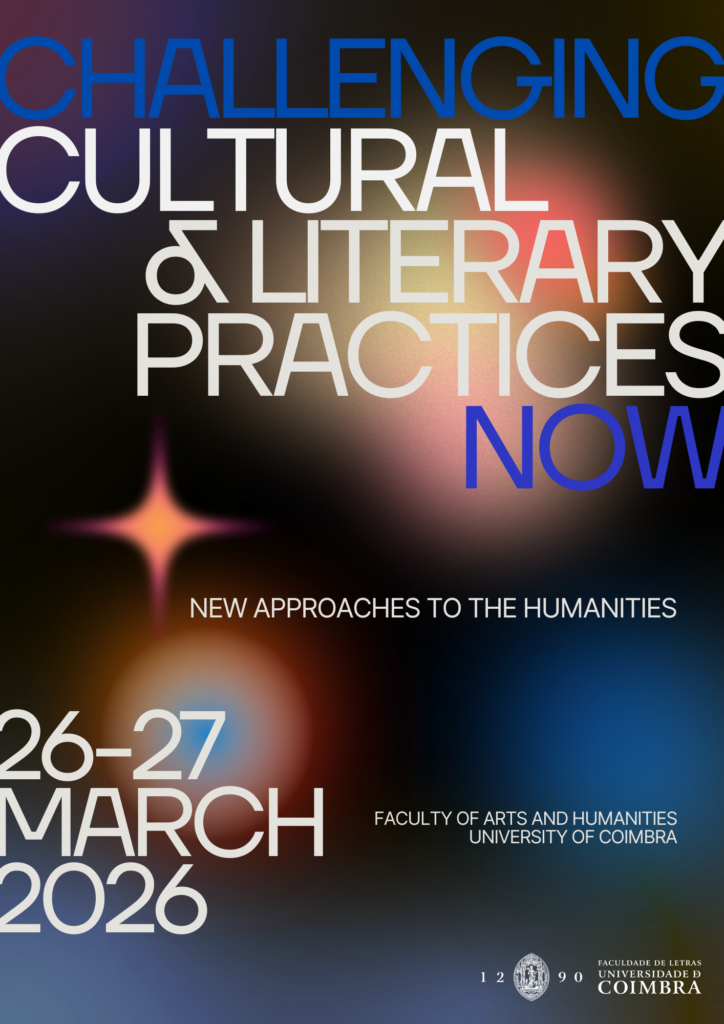
Challenging Literary and Cultural Practices, Now: Contemporary Approaches to the Humanities.
Host and dates: Faculty of Arts and Humanities, University of Coimbra, Portugal. 26-27 March 2026.
Deadline for submissions: 31 December 2025.
Event presentation
We are pleased to announce the first edition of the Postgraduate Symposium “Challenging Literary and Cultural Practices, Now: Contemporary Approaches to the Humanities” , to be held on 26-27 March 2026 at the Faculty of Arts and Humanities of the University of Coimbra (FLUC), Portugal. This symposium intends to bring together postgraduate students (MA and PhD levels) and early-career researchers from various academic backgrounds in the Humanities and Liberal Arts to discuss their research projects or other works in progress related to literatures and cultures in the diSerent languages taught in the Department of Languages, Literatures and Cultures (English, French, German, Italian, Spanish and Portuguese), but we keep English and Portuguese as the working languages. This symposium will also serve as a platform for networking and sharing experiences as early career academic researchers, in a supportive and collaborative environment.
The program will include both lectures and panels, alongside other less formal discussion formats and will take place in person, at FLUC.
Submissions
Submissions must include an abstract (between 250-300 words) and a brief biographical note (max. 150 words), including the participant’s name, affiliation, academic status, and email address.
Contact details: challengingsymposium@gmail.com
CFP
For further details, please check the event original call inserted below.
(Posted 4 November 2025)